

 The dark web is a sales hub for stolen data, primarily account logins, personal information, credit card details, and email addresses. Stolen business data leads to targeted attacks, ransomware attacks, data breaches, financial losses, and reputational damage.
While business owners and executives focus on innovation and growth, sensitive company information, from employee credentials and customer information to proprietary documents, could already be exposed and circulated undetected on the Dark Web. How do you protect your business? Dark Web scanning services.
What are Dark Web Scanning Services for Business?
Constant scanning is performed to monitor and
find stolen credentials and personally identifiable information (PII) on the Dark Web. The monitoring focuses on cyber threats that may impact the business by looking at top-level email domains.
Business professionals are then notified of the risk, so they are empowered to change passwords, deactivate unused accounts, review account settings, and enable multifactor authentication (MFA).
Could your business be exposed?
It is possible. Stolen credentials, customer information, and other business data can circulate after phishing attacks, malware infections, third-party breaches, accidental exposure, or other security incidents. Dark web monitoring can help identify potential exposure earlier, so your team can investigate and respond.
Stolen Credentials Purchased on the Dark Web Drive Costly Business Breaches
Stolen or reused credentials remain one of the most common ways attackers gain access to business systems. Verizon’s 2025 Data Breach Investigations Report found that credential abuse was the leading initial access vector, appearing in 22% of confirmed breaches reviewed in the report.
A dark web alert does not confirm that an attack has occurred. It does, however, give your business a reason to investigate promptly, especially when an exposed credential belongs to an executive, administrator, finance employee, or user with access to sensitive systems.
IBM’s 2025 Cost of a Data Breach Report found that malicious insider incidents had the highest average breach cost among initial attack vectors, at $4.92 million. This reinforces why credential protection, multifactor authentication, employee training, and timely incident response matter together.
The Dark Web: Hidden Threats to Your Business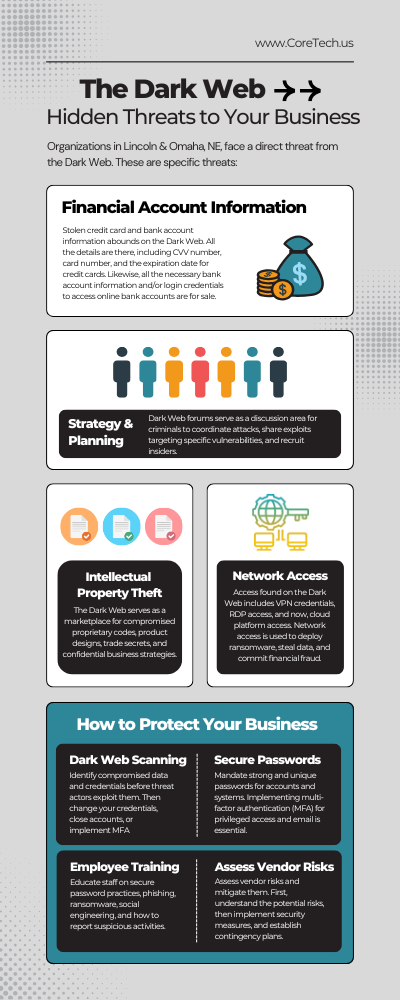
Organizations in Omaha and Lincoln face a direct threat from the Dark Web, as it serves as a haven for illicit activities. Here are specific threats:
- Financial Account Information - Stolen credit card and bank account information abound on the Dark Web. All the details are there, including CVV number, card number, and the expiration date for credit cards. Likewise, all the necessary bank account information and/or login credentials to access online bank accounts are for sale.
- Intellectual Property (IP) Theft - The Dark Web serves as a marketplace for compromised proprietary codes, product designs, trade secrets, and confidential business strategies.
- Network Access - The most common types of network access found on the Dark Web are VPN credentials, RDP access, and now, cloud platform access. Network access is used to deploy ransomware, steal data, and commit financial fraud.
- Strategy and Planning - Dark Web forums serve as a discussion area for criminals to coordinate attacks, share exploits targeting specific vulnerabilities, and recruit insiders.
Is Your Business on the Dark Web?
Without Dark Web scanning and monitoring, you may never know your business-critical information is there until one of the following occurs:
- Third-party breaches by vendors, suppliers, and partners who have suffered a data breach themselves
- Phishing and malware attacks will occur when cybercriminals get a hold of business user credentials. They will then harvest more credentials or steal sensitive data and files.
- Accidental exposure: Misconfigured cloud storage, databases, or code repositories can leak data that ends up on Dark Web markets.
- Insider threats: Disgruntled employees or those compromised by external actors may deliberately steal and sell data.
Protect your Business from the Dark Web
Dark Web monitoring tools identify compromised data and credentials before threat actors can exploit them. Then you can change your credentials, close accounts, or implement MFA. Your business will also want to do the following:
- Use Secure Passwords. Mandate strong and unique passwords for accounts and systems. Implementing multi-factor authentication (MFA) for privileged access and email is essential.
- Invest in a password manager to make it easy for employees with numerous accounts and passwords to store them securely.
- Implement employee training to educate staff on secure password practices, phishing, ransomware, social engineering, and how to report suspicious activities.
- Assess vendor risks and mitigate them. First, understand the potential risks, then implement security measures, and establish contingency plans.
How Does Dark Web Scanning Work?
Dark web monitoring services search sources that may include criminal forums, breach-data repositories, marketplaces, paste sites, and other available channels for information associated with your organization.
Depending on the service, monitoring may look for indicators such as:
-
Company email domains and employee email addresses
-
Usernames and compromised credentials
-
Business names, brands, or domains
-
Customer or employee data that appears in a known breach
-
References to publicly disclosed data leaks or other relevant exposures
When a potential match is found, the value comes from investigating it quickly, determining whether the information is current and relevant, and taking proportionate action to reduce risk.
What Should Your Business Do After a Dark Web Alert?
A dark web alert should start an investigation, not create panic. The right response depends on what was found, who is affected, and whether the information is still active.
Compromised credentials deserve especially prompt attention because attackers can use them for account takeover, phishing, and business email compromise. Learn more about how compromised credentials can put your business at risk and how dark web monitoring can help identify them.
If an alert identifies a business email address, username, or password, your team should generally:
-
Confirm whether the account belongs to a current employee, contractor, vendor, or former user.
-
Reset the password and make sure it is not reused on other business or personal accounts.
-
Revoke active sessions or tokens where the affected system allows it.
-
Confirm that multifactor authentication is enabled and review the account’s recovery methods.
-
Review sign-in activity, mailbox rules, forwarding rules, administrator changes, and other relevant logs for suspicious activity.
-
Disable accounts that are no longer needed.
-
Investigate whether the same credential, system, vendor, or user group may create broader risk.
Dark Web Monitoring: Be Vigilant
Dark Web monitoring services offer continuous protection by providing the following:
- Ongoing surveillance: continuous scanning 24x7x365.
- Automated alerts: Get real-time alerts regarding what was found and where, and the potential risk of the compromised data.
- Context and Threat Intelligence: Gain valuable insights into whether it is part of a larger breach or if the data is being actively sold or discussed for an attack. It helps prioritize your response.
- Reporting: Regular reports help organizations understand their overall exposure risk level.
Frequently Asked Questions About the Dark Web
 Below are some of the most frequently asked questions about the Dark Web that businesses should be aware of when it comes to risks and monitoring:
Is my business really at risk on the Dark Web?
Yes, every organization is at risk because confidential data may be circulated on the Dark Web from third-party breaches, phishing, or insider threats.
What business information is for sale on the Dark Web?
Valuable business information is regularly sold on the Dark Web, including: stolen employee credentials, customer data, intellectual property, compromised network access, and internal documents.
How do I know if my organization's information is available on the Dark Web?
Dark Web scanning and monitoring help organizations determine what information is located there. These services continuously search the Dark Web and other parts of the internet for business data.
How do I protect my business from the Dark Web?
Implement deep web monitoring, enforce complex passwords and multi-factor authentication (MFA), patch vulnerable systems, train employees continually, and have a proactive incident response plan to protect your business.
Do I need a long-term strategy to protect my organization from the Dark Web?
Dark Web threats emerge unannounced and are constant. Organizations require continuous monitoring, security improvements, and strategy adaptations over time to remain protected from Dark Web threats.
Be certain to formulate an incident response plan that enables your organization to take specific actions in the event of a cyber attack or data breach.
Dark Web Threats are Hidden and Dangerous
No organization can afford to ignore them.
Partner with an IT managed service provider in Omaha and Lincoln, NE, that has the expertise to develop a tailored security plan that addresses emerging threats, your specific risks, business technology, and growth strategies. Contact us today!