


 Have you ever had your power go out in a storm for more than 30 minutes at home? You dig out the flashlight, hoping the batteries still work. And then you start thinking about your next meal and what you have to prepare it.
So, consider your business risk. The loss of productivity, the inability to serve customers, and the lack of access to your data and files.
Unexpected disruptions are a growing risk for small and midsize businesses in Omaha and Lincoln. Why? Cyberattacks are growing and equipment failures, natural disasters, power outages, as well as human errors are not going away. Our reliance on power and technology has grown and become more complex.
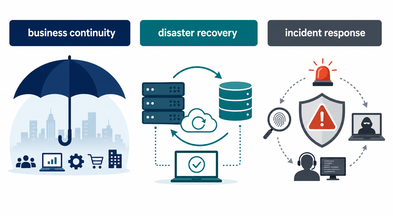
Business continuity and disaster recovery work hand in hand. However, they are not the same concepts and processes. And then there is incident response, which is different as well. It is important to know the difference between the three, so that you may address both in a disaster. First, we will start with business continuity and disaster recovery.
What Is Business Continuity?
Business Continuity keeps critical business operations functioning during and after a disruption to your business.
People, processes, communication, and customer service must all be addressed. What key functions must continue to keep your revenue flowing in? A plan must be in place before a disaster occurs so that your team can adjust and quickly pick up those key functions, possibly without access to impacted tools.
Goals of a Business Continuity Plan
Downtime is costly when a disaster occurs, customers are counting on what you provide, and your ability to deliver services and/or products. With that in mind, a plan to maintain critical business functions becomes a key document. When creating a business continuity plan, focus on the goals you will fulfill. Consider the following:
- Executing on the plan will minimize operational disruption.
- Your customer fulfillment and relationships will keep moving forward.
- Staff productivity is maintained.
- Your revenue is preserved.
It may seem like an ambitious planning process, or more complicated than you have time for; however, the statistics show how important a robust business continuity plan can be. Keep the following in mind and drive forward with your planning:
- 40% of businesses do not reopen following a disaster (FEMA)
- Another 25% fail within one year (FEMA)
- Over 90% of companies fail within two years of being struck by a disaster (US Small Business Administration).
Examples of Business Continuity Strategies
Small and midsize businesses in Omaha and Lincoln need business continuity strategies that are practical and executable. Here are workable strategies to consider: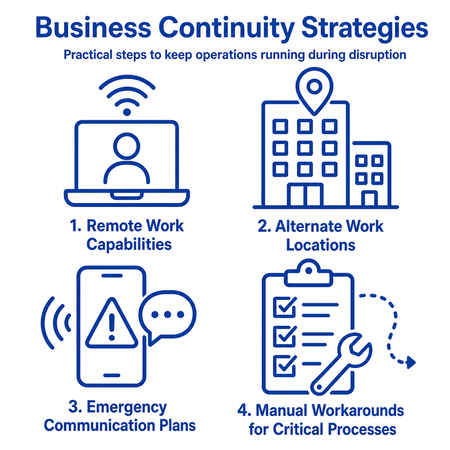
- Remote work capabilities – If a disaster prevents employees from getting to the office, ensure they have what they need to work remotely. Can they access data and/or software through a VPN? Do they have access to the internet? What essential hardware is required? Check into remote work locations such as public libraries, hotels, or cafes.
- Alternate work locations – When you need to keep your team together, check out available alternate work locations. Are hot sites available in your area? These are fully equipped, immediately available backup office spaces. Co-working spaces also have on-demand workspaces where you can rent hot desks or office space for a period of time.
- Emergency communication plans – Determine how you will communicate in different disaster scenarios. This will include both internal and external communication. All employees must know the plans and where to access communications. Will you communicate via a text group, online apps or platforms? Determine how you will communicate with customers and create a backup plan in the event your communication channel is impacted.
- Manual workarounds for critical processes – Identify those processes that must be executed in different disaster scenarios. Plan how you will respond and keep the process moving forward. If you need to execute manually, are all the tools readily available in a kit to do that?
As you can see, there are options to consider. They also require some pre-planning, identification of tools and processes, and forethought about the costs involved.
What Is Disaster Recovery (DR)?
Disaster recovery focuses on restoring critical technology. This includes recovering IT systems, applications, and data after a disruption.
In the event of an electrical outage, flooding, tornado, or other event, you will need an executable process to bring your technology back online. Whether it is a large or small event, your team needs to be prepared.
Goals of a Disaster Recovery Plan
A disaster recovery (DR) plan is crucial for all SMBs in Omaha and Lincoln, NE. Your plan should address disasters of greater magnitude, but you also want to consider interruptions. Interruptions are more likely to occur than a large disaster.
The primary goals of your disaster recovery plan are the following:
-
- Restore systems quickly – Identify the scenarios, steps, and processes that need to be taken. For an SMB, this may include contacting your outsourced IT company. They will launch processes to restore your systems. A proactive managed services provider (MSP) will receive alerts when equipment is not functioning and call you about what is happening. Make sure you also have an emergency number to report what you are experiencing.
- Recover lost or corrupted data – Depending on the disaster or incident, data may need to be restored. A power outage can bring your business to a stop, however your recovery strategy can get you back up and running. Work with your IT support provider to identify your Recovery Point Objective (RPO). An RPO is the maximum amount of data loss that is acceptable during an outage.
- Minimize downtime – One of the measurements to discuss with your IT support provider is the Recovery Time Objective (RTO). Downtime harms the business, so you need to determine the maximum amount of time a system can be down before the impact becomes too great. The RTO helps your IT company and internal team put the right recovery strategies in place.
- Reduce financial impact – The broad objective of the entire plan and the goals above is to reduce the financial impact to your business. Financial impacts include lost revenue, asset damage, loss of customer relationships, increased expenses, or reputational damage.
Addressing these goals in your disaster recovery plan gives your team clear direction and speeds up recovery time.
Examples of Disaster Recovery Strategies
Although there is a lot to consider when developing a disaster recovery plan, your IT staff and outsourced IT partner are here to assist. Managed IT providers have developed plans for businesses in all types of industries and for small and midsize organizations like yours. As an owner or manager, you will want to understand all the areas IT covers and what the RPO and RTO are.
Common disaster recovery strategies include:
-
- Data backups
- Cloud replication
- Server failover
- Recovery testing
- Ransomware recovery procedures
Important note: Your SMB likely uses cloud-based software and data storage. Gone are the days when everything lives on one server and that is the only hardware to backup. And that is not a bad thing.
If you use Microsoft or Google for your email, document delivery, and file storage, you will want to find out the backup solutions available for those systems. You are also likely to use online applications for accounting, customer service, sales, etc. Work with your cloud application vendors for information and documentation on the following:
- Their recovery time and point objectives
- Recovery test verifications
- Communication plans and contacts
- Security controls
- Their business continuity and disaster recovery plans
- Contractual terms that are in place (SLAs)
This information tells you what to expect from your vendors and the service-level agreement (SLA) terms you can hold them to.
Business Continuity vs. Disaster Recovery: Key Differences
Comparison Table
|
Business Continuity |
Disaster Recovery |
|
Focuses on keeping the business running |
Focuses on restoring IT systems |
|
Covers people, processes, facilities, and communications |
Covers technology, applications, and data |
|
Begins immediately during a disruption |
Starts when systems need restoration |
|
Organization-wide strategy |
Technology-specific strategy |
|
Measures operational resilience |
Measures recovery speed |
Why Businesses Need Both Business Continuity and Disaster Recovery
Business continuity keeps operations moving forward. You can execute key processes and functions to support revenue. Disaster recovery restores the technology that supports those essential operations. The two work hand in hand.
When both plans are executed, employees know what to do, and at the same time, technology is brought back online.
Bonus Content:
What is incident response (IR)?
An incident response is specific to cybersecurity, and is a structured approach to help you discover, respond to, and then recover from cyberattacks.
And why does incident response need a separate plan? It addresses your technology from a cybersecurity perspective. Some of the same continuity and recovery strategies apply; however, there are many other processes that are specific to preparing for, responding to, and recovering from an incident.
Goals of an Incident Response Plan (IRP)
Your incident response plan gives you a coordinated, quick and effective response to security incidents. The focus is to return your business operations back to normal while minimizing the overall impact of a breach.
Your business’ incident response plan should include the following goals:
1. Reduce direct impact
-
- Contain the breach: Stop an ongoing attack immediately to prevent further lateral movement, infection, or data loss across your network.
- Minimize downtime: Return impacted infrastructure, applications, and services back to an operational state as quickly as possible to avoid business interruption.
- Protect critical assets: Confirm the integrity and confidentiality of customer data, proprietary business data, and critical IT infrastructure.
2. Manage operational & strategic alignment
-
- Establish clear protocols: Define instructions, individual roles, and chain-of-command so that teams don't waste time figuring out "who does what" during a crisis.
- Manage communication: Facilitate controlled internal and external communication protocols. This includes coordinating updates safely for employees, IT teams, the insurance company, legal counsel, and law enforcement.
- Note regulatory & compliance obligations: Ensure compliance with data privacy laws and cyber insurance criteria regarding mandatory data breach notifications to consumers and government bodies.
3. Post-incident resiliency
Typically, your insurance company and/or IT team will handle the two goals above. Work with them on what to include in your plan and include anything your internal team needs to do or be aware of.
- Preserve evidence: Investigate the source, methodology, and entry point of an incident. Preserve data forensic integrity, which is vital for law enforcement, insurance claims, or prosecution.
- Root cause eradication: Ensure security gaps are fully resolved by completely removing threats (like residual malware or backdoor access) and applying required patches before systems are placed back in production.
- Continuous improvement: Incorporate "lessons learned" from past incidents or drills to update security policies, train staff, and update defensive measures.
Examples of Incident Response Strategies
If you have not already implemented strategies to avoid and recover from cyberattacks, consider the following strategies:
- Protect accounts with MFA
- Keep systems patched and updated
- Train employees to recognize threats
- Maintain and test reliable backups
- Make cybersecurity a leadership priority
Cybersecurity is not a one-and-done project; it is ongoing and changing. Train your employees regularly with educational programs updated to cover current threats. Work with a cybersecurity provider that continually reviews, tests, and updates tools to protect your business.
Lastly, prioritize a culture of cybersecurity with your team, as executives and managers lead the way. Cybersecurity is a business risk that deserves your attention and focus according to the National Institute of Standards and Technology (NIST).
Involve Your IT Partner and Consultant
Business continuity keeps your business running and disaster recovery restores your business technology in the event of a disaster. Incident response helps you discover, respond and recover from a security incident.
To keep your Omaha and Lincoln, NE business running you need all three to minimize downtime and financial loss.
Need help developing a Business Continuity, Disaster Recovery, and Incident Response strategy? CoreTech can help you identify potential risks, protect critical systems and data, and create a recovery plan that keeps your business moving when unexpected disruptions occur. Contact our team of experts today.